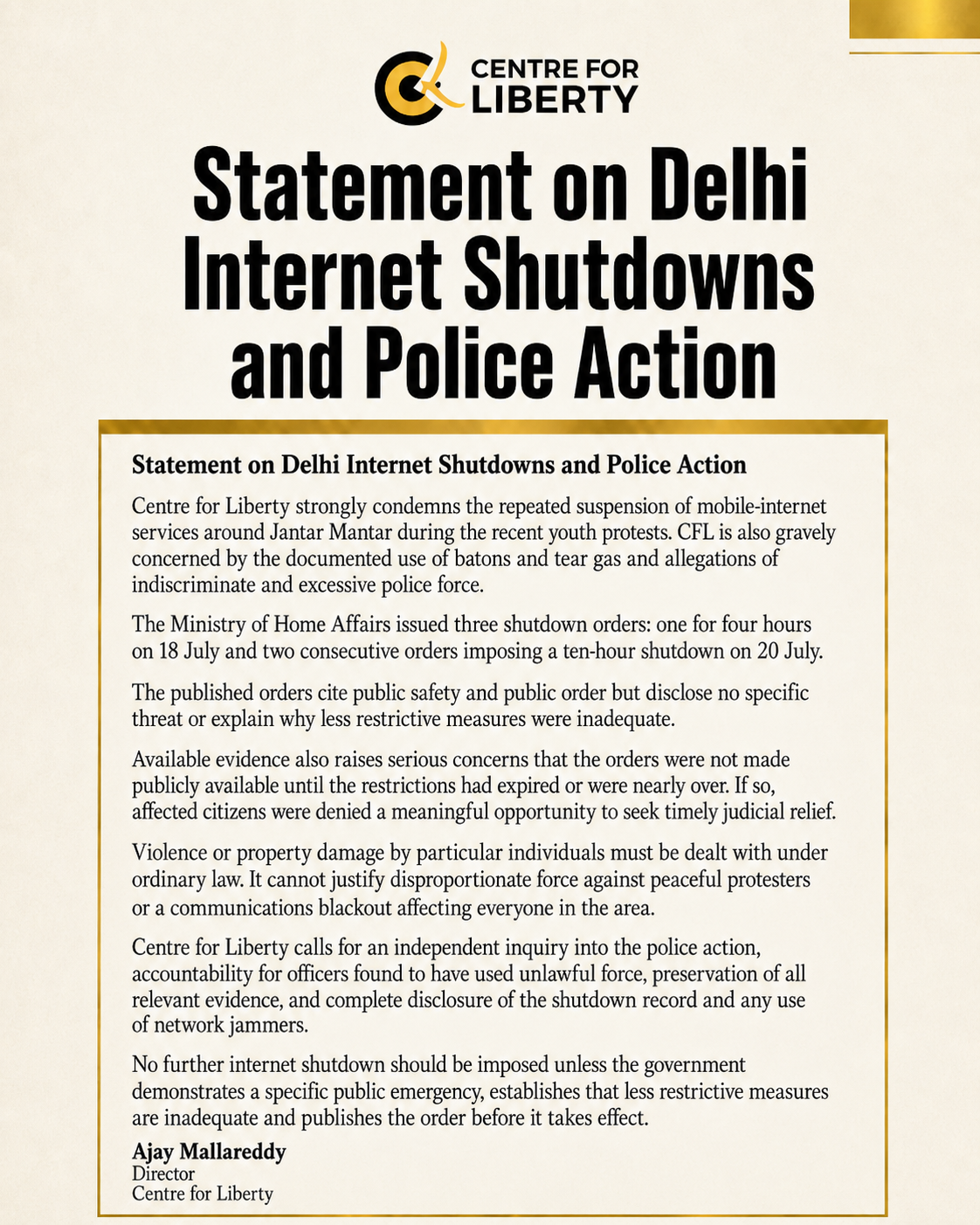
CFL Condemns Internet Shutdowns and Reported Police Excesses Against Delhi Protesters
Hyderabad: Centre for Liberty (CFL) strongly condemns the Union Government’s repeated suspension of mobile-internet services around Jantar Mantar during the youth-led protests in Delhi. CFL is also gravely concerned by the documented use of batons and tear gas and allegations of indiscriminate and excessive force against protesters.
The Ministry of Home Affairs issued three orders suspending mobile-internet services within a 1.5-kilometre radius of Jantar Mantar: one for four hours on 18 July and two consecutive orders imposing a ten-hour shutdown from 8:00 am to 6:00 pm on 20 July.
The published orders invoke public safety, public emergency, public order and the prevention of incitement. However, they identify no specific threat, disclose no supporting facts and provide no explanation of why ordinary policing or less restrictive measures would have been inadequate.
Available evidence raises serious concerns that the shutdown orders were not made publicly available until the restrictions had expired or were nearly over. If the orders were unavailable during most of their operation, affected citizens were left with little or no meaningful opportunity to seek timely judicial relief. The government must disclose when and how each order was first made publicly accessible.
In Anuradha Bhasin v. Union of India, the Supreme Court required internet-suspension orders to be made publicly available so that affected persons could challenge them before the appropriate court. Publishing an order after a shutdown has substantially or completely served its purpose would reduce this safeguard to a formality.
Internet shutdowns during protests are not neutral crowd-control measures. They prevent protesters from contacting their families, lawyers and medical assistance; interfere with payments and livelihoods in surrounding areas; and obstruct journalists and citizens from documenting events as they unfold. They create an information blackout precisely when the coercive power of the state is being exercised.
Reports have also raised concerns that network jammers or other communications-interference equipment may have been deployed. The government must clarify whether such equipment was used, who authorised it and under what legal authority.
Independent reporting confirms that police used batons and tear gas against protesters attempting to march towards Parliament. Protesters have alleged indiscriminate assaults, including violence against women, while Delhi Police have accused sections of the crowd of breaching barricades, attacking personnel and damaging property.
CFL does not defend violence, assault or destruction of property. Individuals reasonably suspected of committing offences should be investigated and dealt with through ordinary law. Their conduct, however, cannot justify indiscriminate or disproportionate force against peaceful protesters.
Even where a demonstration crosses an authorised boundary, the police remain obligated to distinguish between peaceful participants and individuals committing offences and to use only the minimum force reasonably necessary.
CFL demands:
1. An independent and time-bound inquiry into the police action, conducted by a body independent of Delhi Police, with its findings made public.
2. Immediate preservation of all relevant evidence, including CCTV recordings, body-camera footage, drone footage, police communications, duty rosters, detention records and recordings made by journalists and members of the public.
3. Disciplinary and criminal accountability for officers found to have used unlawful or disproportionate force, including senior officers who authorised, directed or knowingly tolerated such conduct.
4. Complete disclosure of the internet-shutdown record, including police recommendations, intelligence inputs, file notings, reasons for rejecting less restrictive alternatives, Review Committee findings and the precise publication history of each order.
5. Full disclosure of whether network jammers or other communications-interference equipment were used, including their locations, duration, approving authority and legal basis.
6. No further internet shutdowns in connection with these protests unless the government establishes a specific public emergency, demonstrates that less restrictive measures are inadequate and publishes the order before it takes effect. In a genuinely unforeseeable emergency, the order must be made public immediately upon issuance.
“The government cannot disable public communication and disclose its legal justification only after the shutdown has served its purpose. Nor can misconduct by some protesters become a licence for indiscriminate force against others.”
— Ajay Mallareddy, Director, Centre for Liberty
Centre for Liberty
Life. Liberty. Property.
Media contact:
Ajay Mallareddy
Director
ajay@centreforliberty.org